
Content warning: This story and accompanying video include personal experiences related to the Sixties Scoop, adoption, grief and intergenerational trauma. Viewer and reader discretion is advised.
Sometimes, what we lose can take generations to find our way back to.
National Day for Truth and Reconciliation (NDTR) is a reminder of the lasting impact of being separated from family, culture, language and community; and of the importance of creating space for reconnection.
At United Way of Calgary and Area, that work happens year-round.
Guided by our Akak’stiman Indigenous strategy, we work alongside Indigenous communities to strengthen relationships, guide investments and create spaces where culture and community can thrive.
One example is our Indigenous Community Connectors:
“I lost everything. I lost my family. I lost my culture. I lost my language.”
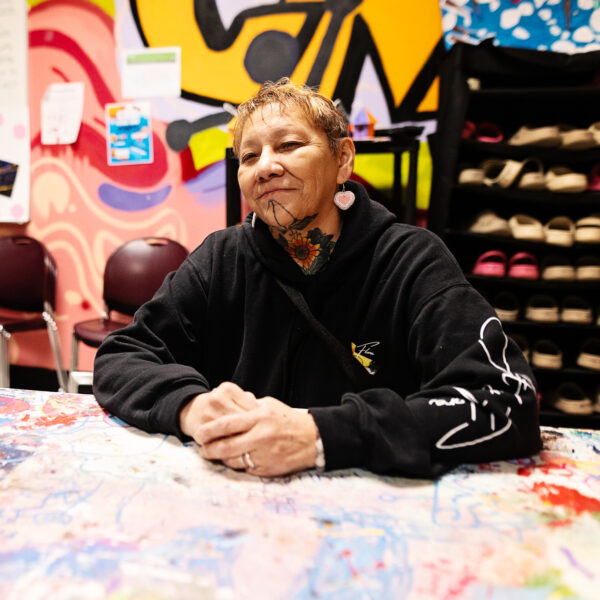 Flora’s life was shaped by the Sixties Scoop, when she was taken from her family, and the only home she’s ever known at only five years old.
Today, connection is at the heart of what she helps create for others.
As one of United Way’s Indigenous Community Connectors at the Greater Forest Lawn Community Hub, Flora brings people together through cultural workshops, traditional teachings and social gatherings.
It’s a space where Indigenous community members can learn from Elders and Knowledge Keepers, practise traditions such as beading, moccasin making and drum making, and strengthen connections to culture and one another.
For some, these moments reach across generations.
One participant shared that, as a child, “it was always like a shame to be Indigenous.” Her mother was adopted, so she grew up without the teachings, traditions and stories that otherwise would have been passed down.
Now, as mother and daughter they are learning together.
“Learning this stuff brings me close back to my home. To my ancestors,” she said. “Together, we’ve been healing.”
For Flora, the journey has also brought her closer to her own family, culture and ancestors.
“You lost something, but you want to find it.”
That search for connection can begin with a teaching, a conversation or simply being welcomed into a space where you belong. For Flora, helping create those moments has become deeply meaningful.
“This gives me purpose.”
Sometimes, the need closest to us is the hardest to name. It can be the ache of disconnection, the absence of something once carried between generations or the quiet hope of finding your way back. United Way’s Indigenous Community Connectors are creating new moments of belonging.
Watch Flora’s story to learn more about what connection makes possible.
These stories are a reminder to listen to Indigenous voices and lived experiences. As NDTR approaches, the resources below offer other meaningful ways to listen, learn and engage on Sept. 30, and throughout the year.
Ways to Observe NDTR
- Wear an orange shirt on September 30 to honour residential school survivors, their families and the children who never returned home. Click here to learn more about the origins of Orange Shirt Day.
- Attend local events: Gathering to listen, learn and reflect with others can be a meaningful way to honour the day. As September 30 approaches, check organizations such as The Confluence Historic Site & Parkland and Werklund Centre for local events and learning opportunities.
- Personalize Your Own Land Acknowledgement: Consider personalizing your land acknowledgement. You can reflect on how you came to live on this land, what you have learned about Indigenous Peoples or how you approach allyship. Click here to learn more.
- Engage with Indigenous stories: Media can deepen our understanding through voices and lived experiences. Consider Holy Angels, a short documentary about the former Holy Angels Residential School in northern Alberta, the University of Calgary’s Truth and Reconciliation Podcast or explore books, films and learning materials through the Calgary Public Library’s Truth and Reconciliation resources.
- Support Local Indigenous-owned Businesses: Shop local at Moonstone Creation, Rainy Chief Trading Post and local markets featuring Indigenous vendors, such as Winter Frost Indigenous Market and the Indigenous Makers Market.
Sept. 30 is a moment to listen and reflect, but the learning can continue beyond NDTR. This can look like the relationships we build, the stories we make space for and the ways we stay connected.
Sometimes, allyship begins simply: by paying attention, staying open and helping someone feel less alone.
The need is close to home. So is the chance to reconnect.